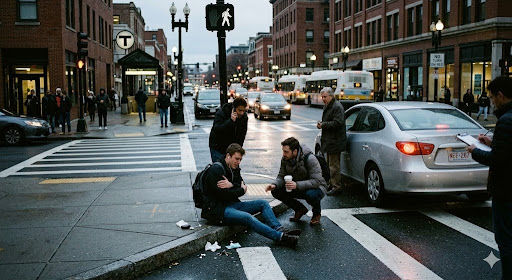
Picture this: someone’s walking home from the T stop, earbuds in, light is green, they’re in the crosswalk. A car turning right clips them. They spin, hit the pavement, and then — nothing. The driver pulls over but looks more annoyed than concerned. A few people stop. Someone asks if they’re okay. They say yes, mostly because they don’t know what else to say.
That’s the moment I’ve been thinking about for years. Not the impact. The moment after, when the person on the ground has about thirty seconds to start making decisions that will matter for months — and nobody around them knows what to say either.
I’ve taken hundreds of calls from people in that exact fog. The thing that strikes me every time isn’t the injury. It’s the fear of saying the wrong thing. So let me walk you through what actually matters, in the order it actually happens.
The First Ten Minutes: Don’t Minimize, Don’t Disappear
The instinct after a crash is to get up, brush off, and say “I’m fine.” Adrenaline is real, embarrassment is real, and nobody wants to be the person causing a scene. But those first ten minutes set the tone for everything that follows.
Call 911, even if you think you’re okay. Emergency services aren’t just for catastrophic injuries. When police respond, they generate a police report — and that document becomes the factual spine of any insurance claim or legal action later. Without it, you’re relying on memory against memory, and insurance adjusters know how to exploit that gap.
Here’s what to gather before anyone leaves the scene:
- Driver information: name, license plate, insurance company, driver’s license number
- Witness contacts: names and phone numbers — people are willing to help in the moment and impossible to find two weeks later
- Photos: the vehicle, its position, the intersection, skid marks, the crosswalk signal, your clothing, your shoes
- Your own condition: note any pain, numbness, or disorientation, even if it seems minor
One more thing: don’t apologize. Not “I’m sorry, I didn’t see you coming,” not “maybe I stepped out too fast.” An apology — even a reflexive social one — can be used later as an admission of fault. You can be kind without accepting blame for something you don’t yet understand.
The First Day: Medical Attention Is Not Optional
Go to the emergency room or urgent care the same day. Even if you feel okay.
Here’s what I’ve seen happen too many times: someone walks away from a crash feeling sore but functional, decides to sleep it off, and wakes up two days later unable to turn their head. Headaches, dizziness, back pain — these symptoms often don’t surface until 48 to 72 hours after impact.
Tell your provider exactly what happened: “I was struck by a vehicle while crossing the street.” Those words matter in your medical record. A vague note about “neck pain” doesn’t tell the same story as “patient struck by motor vehicle, presenting with cervical strain.” Your medical provider is doing two things simultaneously — treating you and creating documentation. That documentation becomes evidence.
Why the timeline matters: Gaps between the crash and your first medical visit give insurance adjusters room to argue your injuries weren’t caused by the accident. Don’t give them that room.
If you were taken by ambulance, you may already have a medical record started. Request copies of everything. Keep them somewhere you can find them.
The First Week: Building Your Case Before You Know You Have One
Get the Police Report
In most jurisdictions, you can request it online or at the precinct within a few days. Read it carefully. Check whether the driver’s information is accurate, whether witness statements are included, and — critically — how fault is characterized. If something is wrong, you can often request a correction or file a supplemental statement.
Move Fast on Surveillance Footage
Traffic cameras, business security cameras, doorbell cameras — footage gets overwritten fast, sometimes within 24 to 72 hours. If the crash happened near a business, a bank, or a busy intersection, ask whether footage exists before it’s gone. This is the kind of evidence that can shift a disputed case entirely.
Understand What the Insurance Call Is Really About
The driver’s insurance company will likely call you. Maybe within days. The adjuster will sound helpful, maybe even sympathetic. They may ask you to give a recorded statement.
You are not required to give one.
You can decline. You can say you’re still receiving medical treatment and aren’t ready to discuss the claim. What you say in that statement can be used to reduce or deny your compensation — and adjusters are trained to ask questions that lead you toward partial fault. Many drivers don’t even report accidents to their own insurers, especially when there’s no visible damage to their vehicle. The adjuster may be working from incomplete information and fishing for yours.
Notifying your own insurance company that the accident occurred is different. That’s a separate obligation — and one you should fulfill.
Understanding Your Rights: Fault, Compensation, and the Clock

Fault in pedestrian accidents is rarely simple. Here’s how the key variables typically interact:
| Factor | Why It Matters |
|---|---|
| Crosswalk vs. jaywalking | Affects presumed fault percentage significantly |
| Signal status at time of impact | Documented by police report and camera footage |
| Driver behavior (speed, distraction, illegal turn) | Can establish negligence independent of your actions |
| Your comparative fault percentage | In many states, 51%+ fault eliminates your right to compensation |
| State-specific fault rules | Some states bar recovery entirely if you share any fault |
Those aren’t rhetorical distinctions. They’re the questions an adjuster or a jury will ask, and the answers need to be documented — not just remembered.
Compensation in pedestrian accident cases can cover medical bills, lost wages, future medical treatment, and pain and suffering. But you have to pursue it within a legal window called the statute of limitations. In Massachusetts, you generally have three years from the date of the accident to file a personal injury lawsuit. Miss that deadline, and you lose the right to sue — regardless of how strong your case is.
Three years sounds like a long time. It isn’t, once you factor in treatment, recovery, and the time it takes to gather records. If your injuries are serious — fractures, head trauma, surgery, extended time off work — consulting a boston pedestrian accident lawyer sooner rather than later protects that timeline and ensures someone is preserving evidence while it still exists.
What If You Already Made Mistakes?
This is the question I hear most often. It carries the most shame.
I already apologized at the scene.I already gave a recorded statement.I left without getting witness information.I waited a week to see a doctor.
None of these things automatically destroys your case. They create complications, not dead ends.
| Mistake | What It Means | What You Can Do |
|---|---|---|
| Apologized at the scene | May be framed as admission of fault | Context and witness accounts can counter this |
| Gave a recorded statement | Statement is now on record | An attorney can help contextualize or challenge it |
| No witness information | Harder to corroborate your account | Police report and surveillance may fill the gap |
| Delayed medical visit | Creates timeline gap for adjusters to exploit | Document the reason for delay; seek care now |
What matters now is what you do from this point forward. Stop talking to the insurance company without guidance. Document everything you remember, in writing, today — even if it’s just a voice memo. And if you’re uncertain about where you stand, a personal injury lawyer can review what you have without charging you for the conversation. Most work on contingency, meaning they don’t get paid unless you do.
The fear of having already made a mistake keeps people from taking the steps that would actually help them. Don’t let that be you.
The Players Involved — and What Each One Actually Does
The entities you’ll encounter after a pedestrian accident aren’t obstacles. They’re tools. Each one serves a specific function, and each one has a window of maximum usefulness.
Emergency services create the official record of the incident and your initial condition.
Police generate the report that frames the facts — including fault characterization and witness accounts.
Your medical provider documents the harm in clinical language that carries weight in insurance and legal proceedings.
Witnesses provide independent confirmation of what happened. Their accounts are most valuable when gathered immediately.
The insurance company processes the financial claim — but on their timeline and in their interest, not yours. Don’t mistake their helpfulness for alignment with your goals.
A personal injury lawyer, if you choose to involve one, levels that dynamic. They handle the clock, the evidence, and the negotiation — so you can focus on recovering.
You Don’t Have to Have This Figured Out Right Now
If you’re reading this from a hospital waiting room, or sitting on a curb somewhere, or lying awake at 2 a.m. replaying what happened — you don’t have to have answers yet.
You’re allowed to be shaken.
What I want you to take from this is simple: the steps exist, they’re manageable, and you haven’t missed your chance. Get medical attention. Get the police report. Write down what you remember. Be careful about what you say to insurance. Know your deadline.
That’s enough for today. The rest can wait until tomorrow.